
18th August 1944
Squadron Leader Eugeniusz HORBACZEWSKI
"Mustang MkIII" # FB355
PK-K
315 Polish Squadron "Debliński"
Velennes (Oise)
Copyright © 2018 - Association des Sauveteurs d'Aviateurs Alliés- All rights reserved -
En français 

Eugeniusz Horbaczewski was born on 28 September 1917 in Kiev (now Ukraine) to Polish parents.
In 1934, drawn to aviation, he began training in gliding, first in Adamkowo and then in Ustianowa, as part of his military preparation, obtaining his glider pilot’s licence in 1935.
In 1936, he continued his secondary education and obtained his school-leaving certificate in Brzesc (now Brest-Litovsk), where his parents had settled in 1928.
In June 1937, he began his training as a powered aircraft pilot at the Aleksandrowice airfield, where, until September, he learnt the basics of flying on an RWD-8 training aircraft. Noted for his enthusiasm and talent for flying, he was named the best student in his class.
In January 1938, he joined the Polish Air Force Cadet School in Deblin, where he was part of the 13th Class; then, in July-August 1939, he undertook a fighter pilot training course at the Ułęż airfield.
He was certified as a fighter pilot with the rank of Second Lieutenant on 1 September 1939, the very day the German Army invaded Poland without a declaration of war.
In the days that followed, he joined a hastily formed fighter squadron equipped with PZL P7s, an obsolete aircraft. He was sent to an airfield further east, from where, between 9 and 11 September 1939, he flew three reconnaissance missions during the Polish campaign without encountering the enemy.
On 17 September 1939, the Soviet Army in turn entered Poland. After desperate fighting on two fronts, outnumbered and outgunned, Poland surrendered on 28 September.
On that same 17 September, Horbaczewski and six other pilots received orders from their commander to cross the Romanian border and then attempt to reach France. Flying their PZL P7s, they landed at Cernauti airfield in Romania (now in Ukraine). Horbaczewski spent the night there before setting off the following day for Gałati, where he had to hand over his aircraft to the Romanian authorities. He was then sent to the Craiova internment camp, from which he escaped.
At the end of September, he arrived in Bucharest and went to the Polish embassy, where he managed to obtain a visa allowing him to travel to Yugoslavia.
A group of 30 Poles, including Eugeniusz Horbaczewski, left Bucharest on 2 October by train, bound for Belgrade. After a few days’ rest, with the support of the British government, the thirty or so airmen made their way to Athens. On 20 October, in the port of Piraeus, the group boarded a ship which docked in Marseille on 28 October.
The Polish airmen were then transferred to the assembly Centre at the Lyon-Bron base, where they were supervised by both their own officers and French officers whilst awaiting their next posting.
On 1 March 1940, Horbaczewski was finally sent to the Bordeaux-Mérignac air base, where he began training on French aircraft.
On 10 May 1940, the Wehrmacht attacked in the West. On 14 June, the Germans entered Paris and, on 22 June, the armistice was signed at Rethondes.
During the Battle of France, around 150 Polish pilots bravely took part in the fighting within the French Air Force, scoring more than 50 victories.
On 24 June 1940, from the port of Saint-Jean-de-Luz, Horbaczewski, along with many fellow countrymen wishing to continue the fight alongside the Western Allies, boarded the Arandora Star bound for England, the island of last hope. Many French people also managed to board at the last minute to join the ranks of the Free French. The ship reached Liverpool on 27 June.
Since the outbreak of hostilities, more than 5,000 Polish airmen had managed to reach Britain. A number of them saw action during the Battle of Britain. The swift defeat of the Polish Army had instilled in all these airmen a deep sense of revenge. Under the agreement between the Polish government-in-exile and the British government, 14 Polish fighter and bomber Squadrons were gradually integrated into the Royal Air Force throughout the war.
Eugeniusz Horbaczewski, after passing through a transit camp near Gloucester, was posted to Blackpool Air Base with the rank of Pilot Officer, but due to health problems, he was forced to spend several weeks in various RAF hospitals.
On 7 November 1940, he entered the No. 15 Elementary Flying Training School in Carlisle, beginning his training on the Tiger Moth. Having completed this first stage, he returned to Blackpool on 27 November and then, at the end of January 1941, joined the 1 (Polish) Flying Training School at Hucknall.
After several months spent at various Royal Air Force schools, he was sent, on 20 July 1941, to No. 58 OTU in Grangemouth, Scotland, a training unit that trained pilots on the famous Spitfire.
On 21 August 1941, he was posted to the prestigious No. 303 ‘Kosciuszko’ Squadron, based initially at Speke and then, from October, at Northolt. During the Battle of Britain, the Polish pilots of this Squadron distinguished themselves particularly and were the most successful, shooting down 126 enemy aircraft.
On 30 August, ‘Dziubek’ (as his crewmates nicknamed him) made his first operational flight in a Spitfire Mk V. This was followed by patrols providing cover for maritime convoys, as well as escort and fighter missions.
On 6 November 1941, over Dunkirk, a Messerschmitt Bf 109 was credited to him as a probable kill. His Spitfire came under anti-aircraft fire but he managed to return to Northolt.
Eugeniusz Horbaczewski scored his first confirmed victory on 4 April 1942 over Saint-Omer, in the Pas-de-Calais, by shooting down a Focke-Wulf 190.
16 April: second victory over the Le Havre area, where a Messerschmitt Bf 109 exploded under his fire.
On 19 August 1942, he took part in the second wave tasked with providing cover for Operation Jubilee at Dieppe, where fighting was raging on land, at sea and in the air. A Focke-Wulf 190 crashed to the ground, struck down by his machine-gun fire. On his return, he celebrated his third victory by performing a barrel roll as he flew over Northolt airbase.
His skills as a pilot and his mastery in combat were clearly evident.
On 10 September 1942, Eugeniusz Horbaczewski was transferred to No. 302 ‘Poznański’ Squadron, based at Heston, where he continued his missions.
By this time, he had already flown 65 combat missions. Promoted to Flying Officer, he was given a leave of absence and returned, on 1 December 1942, to No. 58 OTU as an instructor.
By the end of 1942, air activity in Western Europe had seen a marked decline in intensity. The Luftwaffe was then engaged on the Eastern Front as well as in North Africa.
The Polish General Staff sought to train experienced personnel for the reconstruction of its future air force after the war. In agreement with the British High Command, it was decided to send a group of Polish pilots to the theatre of operations in North Africa.
The selection criteria required one year’s service in a unit and at least 30 operational sorties.
In early 1943, keen to return to combat, Flight Officer Horbaczewski met these criteria and volunteered. Out of a total of 68 pilots, 15 were selected, including Horbaczewski. This combat group took the name Polish Fighting Team. Command was entrusted to Squadron Leader Stanisław Skalski, an ace who already had 15 victories to his name.
On 13 February 1943, Horbaczewski, who had been promoted to Flight Lieutenant, joined the base at West Kirby, where the selected airmen were assembled until 19 February. There they were issued with their equipment, underwent a survival course in desert conditions and were vaccinated against tropical diseases.
Having set sail from the port of Glasgow on 23 February aboard a transport ship, the PFT pilots disembarked in Oran on the morning of 4 March and were then transported by train to Algiers before travelling on to Tunisia. In mid-March, the PFT set up camp in rudimentary tents at Boughrara airfield, 360 km south of Tunis, and joined Flight ‘C’ of RAF 145 Squadron. The entire Desert Air Force, tasked with supporting Montgomery’s 8th British Army, was commanded by the American ace Lance C. Wade. Initially equipped with tropicalised Spitfire Mk V aircraft, it began operations on 18 March. On 26 March, it was re-equipped with the more modern Spitfire Mk IX.

Polish Fighting Team in Tunisia – Eugeniusz Horbaczewski is seated on the left.
On 28 March 1943, during their fourth operational sortie, the PFT pilots spotted, over Sfax, a formation of Heinkel 111s escorted by Messerschmitt Bf 109s, followed by another formation of seven twin-engine Junkers 88s, which were immediately engaged by S/Ldr Stanisław Skalski and F/Lt. Horbaczewski. Two Ju-88s were shot down, one by Skalski, the other by Horbaczewski, who claimed his fourth victory. On that day, the Polish Fighting Team recorded its first two victories in the skies over North Africa.
Eugeniusz Horbaczewski, whilst on patrol, claimed another victory on 2 April when a Messerschmitt Bf 109 was shot down in flames. This fifth victory earned him the status of an ace.
The Polish pilots, who faced the experienced pilots of the Luftwaffe and the Italian Air Force during the final phase of the Tunisian campaign, were building a solid reputation, distinguishing themselves through their aggressiveness, efficiency and tactical mastery. The PFT quickly became known as the ‘Skalski Circus’.
During another sortie on 6 April, F/Lt. Horbaczewski attacked a formation of five Messerschmitt Bf 109s and added a sixth victory to his tally. However, his Spitfire was hit during the dogfight. He was preparing to bail out of his burning aircraft but, after a half-barrel roll, the flames died down. He managed to land his damaged Spitfire at Gabes, behind friendly lines. Reaching the Boughrara base by car the following day, he was greeted with great enthusiasm as he had been prematurely declared missing in action.
22 April 1943 was a day of glory for the Polish pilots. Three of them each scored a double victory. A rare feat within a single Squadron! On that day, F/Lt. Horbaczewski secured his 7th and 8th victories by shooting down two Me Bf 109s over the Bay of Tunis.
From 18 March to 12 May 1943, the date of the official disbandment of the ‘Skalski Circus’, the Polish pilots had caused a sensation by destroying 25 enemy aircraft, with a probable 3 more, and damaging 9 others in 6 weeks, at the cost of a single pilot, F/O Mieczysław Wyszkowski, who was shot down on 18 April and subsequently captured behind enemy lines.
Their exceptional skill and reputation quickly spread beyond the North African front, becoming a symbol of the excellence of Polish airmen. F/Lt. Horbaczewski held the PFT’s best record with five victories to his name.
In May 1943, following the surrender of the Afrika Korps, the British offered to promote the PFT pilots to command posts within units based in the Mediterranean region. Only three of them accepted, including F/Lt. Horbaczewski. The remaining 11 pilots gradually returned to Britain.
On 22 June 1943, he was temporarily assigned to No. 601 RAF Squadron before taking command, on 6 July, of Flight A of 43 Squadron at Hal-Far airfield in Malta, in preparation for the invasion of Sicily and then Italy.
On 27 July, during a mission with two other pilots (one British and one Canadian), a Messerschmitt Bf 109 was shot down over Reggio Calabria, Italy. On their return, during the debriefing, Eugeniusz Horbaczewski declined to claim the victory, allowing it to be credited to his two wingmen.
On 9 August, he took command of No. 43 Squadron with the rank of Squadron Leader. He was one of three Polish officers to command an RAF squadron.
He scored his 9th, 10th and 11th confirmed victories whilst serving with No. 43 Squadron over southern Italy and Sicily: on 4 September, by shooting down a Me Bf 109, and then on 16 September, whilst on patrol over Salerno, by shooting down two FW-190s in less than 40 seconds.
On 13 October 1943, he left No. 43 Squadron and returned to Northolt airbase in England. He was tipped to command No. 303 Squadron but, suffering from viral hepatitis, he was sent to Scotland, to the Polish Paderewski Hospital in Edinburgh, where he stayed until December.
On 15 February 1944, in Heston, he finally took command of No. 315 ‘Dębliński’ Squadron (named after the town of Dęblin), where most of its pilots had originally been trained.

On 20 February, at the head of his Squadron, his missions began. They would follow one after another over France, northern Europe, and as far as Norway, during perilous low-altitude attacks on railway and port facilities and other Nazi strongholds.

F/Lt Przymienski, F/O Swistun, S/L Horbaczewski, F/O Nowosielski, F/Lt Cwynar, W/O Jankowski and W/O Bedkowski.
Through his innate sense of team spirit, his loyalty and kindness towards his crew, his experience, and his warm and friendly manner during briefings, S/Ldr Horbaczewski was highly regarded and strengthened the cohesion within his Squadron.
On 26 March 1944, No. 315 Squadron, equipped with North American ‘Mustang III’s’ to replace the Spitfires, moved to Coolham Airfield, in Sussex.
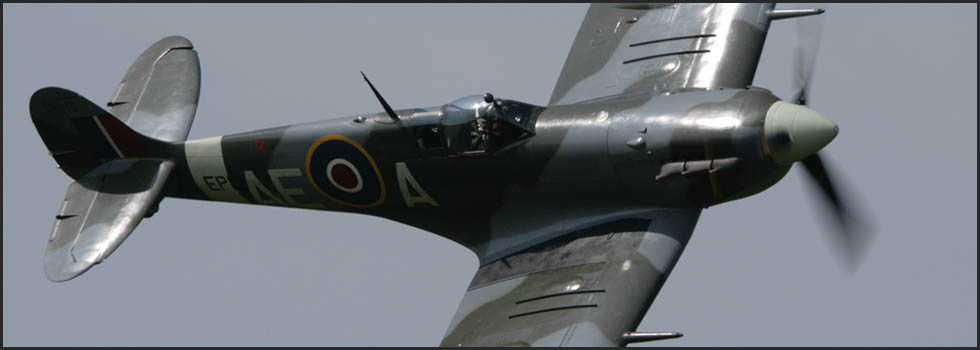
The Mustang III was a versatile fighter-bomber, highly manoeuvrable and faster than the Spitfire. Drop-tank fuel tanks provided greater range for long escort missions. It was armed with six .50 caliber Browning machine guns in the wings and could carry two 500 lb bombs.
Until mid-April, a training period took place at Llanbedr Air Base in Wales to enable the Polish pilots to adapt to and master this new aircraft, particularly for ground attack and dive-bombing missions. Missions then resumed against enemy installations in France in preparation for the forthcoming D-Day landings.
No. 315 Squadron, the Polish No. 306 ‘Toruński’ Squadron and the British No. 129 ‘Mysore’ Squadron then formed part of No. 133 Wing (commanded by Stanisław Skalski) within the 2nd Tactical Air Force. This had been created to protect the airspace during the forthcoming opening of the new front in Western Europe, somewhere between Brittany and the Belgian coast.
On 29 April, S/Ldr Horbaczewski suffered a minor head injury when shrapnel from an anti-aircraft shell struck the cockpit of his Mustang, but he managed to return to base.
From May onwards, S/Ldr Horbaczewski, commanding 315 Squadron, also took part in bomber escort missions during their raids on Germany.
On 20 May, during a ‘Ramrod’ mission (ground attack) involving 12 aircraft, No. 315 Squadron suffered the combat loss of its first Mustang. F/O Stanisław Caliński was killed during his 48th mission when his aircraft crashed near Longueil-Sainte-Marie following a dive-bombing attack on Verberie railway station.
On 6 June 1944, as part of Operation Overlord, No. 315 Squadron took part in Operation Mallard. Twelve Mustangs, led by S/Ldr Horbaczewski, took off at 20:20. The aircraft now bore black and white stripes on the upper and lower surfaces of the wings and on the rear of the fuselage so that they could be quickly identified in the heat of battle. Their mission was to escort aircraft towing Horsa and Hamilcar gliders loaded with heavy equipment and troops to be dropped around Ranville. The aim of this operation was to reinforce the bridgehead on the eastern flank of the D-Day landings, held since the previous night by the British 6th Airborne Division, and to contain any possible German counter-offensives. The No. 315 Squadron’s mission proceeded without incident. No enemy fighters were encountered.
From then on, in the skies over Normandy, the pilots of No. 315 Squadron took part in daily fighter, bombing and air-cover missions (sometimes several a day). Their targets included bridges, viaducts, railway stations and junctions, as well as any enemy concentrations on the ground, with the aim of preventing the flow of troops towards the front.
During one such mission, on 10 June, F/Lt. Adam Sworniowski’s Mustang was hit by heavy anti-aircraft fire whilst on a ground attack mission. Having managed to bail out safely from his burning aircraft, he landed north-east of Caen, near a concentration of tanks. Whilst attempting to flee to the Allied lines, he was probably murdered by German soldiers.
On the morning of 12 June, during a reconnaissance mission led by S/Ldr Horbaczewski, a formation of seven Focke-Wulf 190s was intercepted. After a brief dogfight, Horbaczewski secured his 12th victory by shooting down one of them over Sées, in the Orne. Three others were shot down by two of his wingmen.
On 22 June 1944, No. 315 Squadron’s mission targeted Cherbourg and its deep-water port, a location of great strategic importance that was still under German control. The area was heavily fortified with numerous tanks, artillery positions and hundreds of machine-gun nests. Having taken off at around 12:00, the mission unfolded in two stages: first, the dropping of bombs on armoured units in the Octeville sector, followed by strafing enemy positions on the ground.
During this attack, No. 315 Squadron lost another of its pilots, F/Lt. Henryk Stefankiewicz, who was shot down south of Cherbourg after being hit by anti-aircraft fire. Also caught in the intense anti-aircraft fire, another Mustang was hit. Its pilot, W/O Tadeusz Tamowicz, radioed that he could not return to England. He managed to land, with the landing gear retracted, in a marshy area between the front lines. His aircraft quickly began to sink into the mud. Wounded in the legs, he managed to extricate himself from his Mustang and then waded through the marshes to some nearby bushes. He removed his flight gear, which he left to dry in the sun, and then applied bandages to his wounds. Eugeniusz Horbaczewski had been watching the scene whilst circling at low altitude above his comrade, who signalled to him that he was alive, though wounded.
After handing over command of the mission to F/Lt. Pietrzak, Horbaczewski looked for a place to land. Near Azeville, he spotted an airfield being constructed by an American engineering unit. He flew low over the runway, wagging his wings to signal that he was about to land, then turned away and set his Mustang down. After explaining the reason for his presence, he borrowed a Jeep and headed towards the area where his wingman had gone down. Unable to get close to him, he had to walk about 400 metres before reaching him. To his great surprise, W/O Tamowicz suddenly spotted his Squadron Leader coming to his rescue. The Mustang had, in the meantime, disappeared into the marsh. He got dressed and then clung tightly to Horbaczewski’s shoulder. Wading through the marshes, the two of them made their way back to the Jeep and, a few minutes later, to the airfield.
The Americans then wanted to take W/O Tamowicz into their care and take him to a hospital. Horbaczewski firmly objected. Tamowicz was surprised by his commander’s decision. Although designed for a single occupant, Tamowicz was seated in the Mustang’s cockpit before Horbaczewski sat on his lap. To make more room, the parachute was left behind. Then, to the cheers of the Americans, the aircraft took off at full throttle, cockpit open, heading for England.
At Coolham Airfield, the ground crew were relieved to finally see their Squadron Leader’s Mustang land. Rushing over to the aircraft, they were astonished to see two men climbing out of the cockpit. W/O Tamowicz was quickly taken into the care of the medical team and treated. This heroic act, Horbaczewski’s bravery and this extraordinary rescue have gone down in the annals of the Royal Air Force.

On 24 June, during a mission of No. 315 Squadron over the Eure, W/O Jan Adamiak was shot down by a Focke-Wulf 190.
The missions of No. 315 Squadron, in support of Operation Overlord, concluded on 7 July with an attack on German forces in the Eure.
Thus, from 6 June to 7 July 1944, No. 315 Squadron had contributed significantly to the success of the Allied landings by carrying out 445 missions. During this period, the Polish pilots were credited with 13 confirmed victories but lost three of their own on 10, 22 and 24 June.
From July 1944, No. 315 Squadron, now based at Brenzett in Kent, was assigned to defend London and southern England, which were being targeted by V1 flying bombs that were terrorising the civilian population and attempting to demoralise them. Between 19 and 29 July, S/Ldr Horbaczewski claimed four victories in the skies over England and the English Channel.
On 30 July, ten Mustangs from No. 315 Squadron, fitted with auxiliary fuel tanks, took off from Brenzett on a mission to escort 48 Beaufighter torpedo bombers. Their objective was to sink, along the Norwegian coast, German ships transporting ore from the port of Bergen to the Third Reich. Over the North Sea, four Mustangs were forced to return to England due to mechanical failures or bad weather. The other six continued this long-range mission, during which eight enemy aircraft were shot down off the coast of Stavanger. S/Ldr Horbaczewski, after firing a three-second burst, claimed a Me Bf 109 which crashed into the sea. It was his 13th victory. He hit another Me Bf 109 which was eventually shot down by F/O Nowosielski. The victory was shared.

On 18 August 1944, the ‘Rodeo 385’ mission by No. 315 Squadron, ordered by Fighter Command, was to reinforce Allied air superiority over France, in the Le Touquet-Cormeilles-Romilly triangle, and to attack any targets that came into view.
S/Ldr Horbaczewski had been feeling unwell for several days due to a severe bout of flu. However, neither the medical staff nor his fellow pilots could dissuade him from taking part in this mission. That day, he confided to one of the Squadron’s intelligence officers his foreboding that, should they encounter the enemy, he would not return... but his mind was made up. As his usual aircraft was undergoing maintenance, he took his place in a reserve Mustang.
The formation of twelve Mustangs, divided into three sections (Red, Blue and Yellow) of four aircraft each, took off from Brenzett at 7.15 am. Led by its Squadron Leader, it began the crossing of the English Channel over Brighton and then, at an altitude of 8,000 ft, crossed the French coast at Ault, where it came under fire from anti-aircraft batteries without sustaining any damage.
At around 08:00, whilst flying over the outskirts of Beauvais-Tillé airfield under a cloudless sky, the radio silence was broken by W/O Tadeusz Słoń, who reported the presence of Focke-Wulfs below. Surprisingly, S/Ldr Horbaczewski did not reply. His radio appeared to be out of order. The Polish pilots jettisoned their auxiliary fuel tanks and, taking advantage of their speed and altitude, dived like lightning to engage in combat with around 60 Focke-Wulf 190s of JG26. Some of them were gathering to the north-east of Beauvais, whilst others were taking off, causing the grass on the runway to ripple.
During the ensuing swirling dogfight, sixteen enemy aircraft were shot down, one was probably shot down and three others were damaged. S/Ldr Horbaczewski was credited with three victories.
At the end of the engagement, which lasted around 20 minutes, the Polish pilots regrouped at altitude around F/Lt. Pietrzak, the deputy leader, and quickly realised that their S/Ldr was missing. F/O Nowosielski and F/Sgt. Bargielowski had seen him shoot down three Focke-Wulf 190s, but no one had seen him go down. They flew back over the area without spotting any sign of him before heading for their base. As their radio appeared to be out of order, they all hoped that their Squadron Leader was making his way back to England alone.
On 18 August, No. 315 Squadron had recorded the highest number of victories for any RAF Squadron in a single air battle during the Second World War. The courage, determination and skill of the Polish pilots were the decisive factors in this great success.
Attack summary :
|
S/Ldr Eugeniusz Horbaczewski |
PK-K |
3 FW-190 |
|
F/Sgt. Kazimierz Siwek |
PK-B |
3 FW-190 |
|
F/Lt. Henryk Pietrzak |
PK-A |
2 ½ FW-190 |
|
F/Sgt. Jakub Bargiełowski |
PK-I |
2 FW-190 + 2 FW-190 damaged |
|
W/O Tadeusz Słoń |
PK-O |
1 ½ FW-190 |
|
F/O Bożydar Nowosielski |
PK-X |
1 FW-190 |
|
P/O Gwidon Świstuń |
PK-U |
1 FW-190 + 1 FW-190 probably destroyed |
|
F/Sgt. Kazimierz Kijak |
PK-M |
1 FW-190 + 1 FW-190 damaged |
|
F/Lt. Jerzy Schmidt |
PK-Z |
1 FW-190 |
The other Polish pilots who took part in this battle were F/Sgt. Boleslaw Czerwiński, F/O Piotr Kliman and P/O Aleksander Judek.
F/Sgt. Kazimierz Siwek was killed on 13 September 1944, returning from a mission, approximately 1 km from Brenzett airbase, for unknown reasons.
F/Lt. Jerzy Schmidt lost his life on 6 December 1944, returning from an escort mission over Norway. Following engine failure, he decided to ditch his aircraft off the Shetland Islands. His body was never recovered.
No. 315 Squadron received a message of congratulations from the RAF High Command expressing their gratitude to the pilots and members of the Squadron. The excellent fighter skills and fighting spirit of the Polish pilots during the battle of 18 August were praised and added to the long list of exploits achieved by the Polish Air Force as a whole during the war.
However, at Brenzett, the wait seemed endless. With every passing hour, hopes of seeing their commander return dwindled. S/Ldr Horbaczewski was then officially declared missing. There was a sense of shock. Consternation was written all over the faces of the base personnel. Had he been rescued on the ground by the local population in France? Had he been captured? Yet the hope that he was still alive remained.
In Velennes, a small village near the Beauvais-Tillé airfield, three young boys, Daniel Loncke, 14, and Constant Loncke, 7, were in front of the family farm gate with their 8-year-old friend Michel Lasne.
Testimony of Michel Lasne, collected in 1997 and updated in 2018:
“We were practically born with the air battles over the Beauvaisis region, because my friends and I were born in the mid-1930s!
Our village of Velennes is located less than 2 km as the crow flies from the northeastern edge of the Beauvais-Tillé airfield, which was strategically very important during the last war, from 1939 to 1945! In short, it meant I lived with warplanes for six years; at the end of the conflict, I was only 9 years old! You could say that we watched not dozens, but at least a hundred air battles unfolding above the runways of Beauvais-Tillé in a war that, for us kids, seemed like an eternity; it seemed so long, so very long, since we were practically born with it. It ended when we had passed the age of reason!
One morning, there was some heavy gunfire up there, but no more than usual. We were on school holidays, so we were free to move around and watch what was happening in our surroundings. The fighting was taking place above the runways towards Nivillers, Bonlier, and Tillé; German planes were taking off and flying very low over our rooftops, heading north… As usual, the fighting lasted barely twenty minutes, but during that time, something significant happened for us. In the middle of the battle, there was a loud noise near the Chemin des Noettes, not exactly an explosion, but a very loud crash… All the villagers, puzzled for a moment, quickly went to the scene. It was a British fighter plane, broken in two, its nose buried in the earth after hitting a rise in the slope.
The Germans were already there, preventing the plane from approaching. Black smoke… rising into the sky. This didn't seem to overly concern the German soldiers, who weren't worried about an explosion as they worked on the wrecked plane. These men belonged to the Luftwaffe Fire Brigade at the Beauvais-Tillé airbase, accustomed to this kind of disaster. They then left for other tasks, which were plentiful for them that morning…
In the afternoon, with my sisters Reine, Odette, Gisèle, and my brother Marcel, we decided to go and place flowers on the remains of our Allies' plane, whose pilot had not been found among the wreckage…
We picked flowers from our garden, including large dahlias, and set off towards Les Noettes. Cautiously, we approached the plane, which had stopped smoking… We avoided drawing too much attention to ourselves because we feared the occupiers, whose reactions were always unpredictable… That afternoon, a strong wind and a storm had risen over the plain. Suddenly, its force caused a piece of sheet metal, not completely detached from the wreckage, to move. This metal battered against the inert carcass. We were terrified; our hearts pounded wildly, for we thought a German with a rifle had spotted us! As one, we jumped back to hide behind a thicket, from where we watched the dangling piece of aluminum intermittently striking the abandoned fuselage. It wasn't a German! How frightened we were! Nevertheless, with the stealth of Sioux warriors, on tiptoe, anxious but courageous, we approached the unfortunate wrecked fighter plane. We scanned the surroundings. No one in sight, no one near the aircraft! So, resolutely, we laid our flowers and left quickly, happy and relieved to have performed our act of gratitude towards the missing airman who may have parachuted, as we had no idea what had become of him”.

Velennes - The crash site

Velennes, October 2017 - Michel Lasne and Constant Loncke at the crash site.
For the two friends, the drama of 18th August 1944 remains an indelible memory.
A few days after the dogfight on 18 August, the Germans went to the small village of Velennes, where an Allied aircraft had crashed in a field. It had not caught fire, nor had it exploded, but had sunk deep into the ground. The rear section of the fuselage and the shattered wings left on the surface were removed, the machine guns recovered, and the crater caused by the impact was filled in. The farmer who owned the land could once again cultivate his fields.
In 1945, after the end of hostilities in Europe, the prisoner-of-war camps in Germany were liberated and gradually emptied, but there was still no trace of S/Ldr Horbaczewski. It then became clear that he had been killed in action, but no one could yet determine the location or circumstances.
From then on, through the French Red Cross, his mother, Anna Horbaczewski, began searching for him, but her efforts proved fruitless.
In February 1947, representatives of a British commission from the Missing Research and Enquiry Unit began their investigations and questioned residents living near Beauvais-Tillé airfield. The existence of an aircraft bearing RAF roundels, which had crashed at Velennes on the morning of 18 August 1944, led to the assumption that it could potentially be Eugeniusz Horbaczewski’s Mustang.
On 3 March 1947, excavations were finally undertaken at the site by the M.R.E.U. in cooperation with the French Red Cross. After digging deep into the ground for over an hour, the Polish officer’s body was found beneath his aircraft’s engine and formally identified. It then became clear that he had probably been shot down by a Luftwaffe fighter, his aircraft having nosedived and crashed violently at high speed.
S/Ldr Eugeniusz Horbaczewski was buried the following day in Creil’s municipal cemetery where he still rests today alongside 54 other Royal Air Force airmen who fell in the Creil area, most of them during the terrible year of 1944.

His grave in the cemetery of Creil (Oise)
Third best Polish fighter ace during WWII, S/Ldr Horbaczewski flew a total of 250 war missions during which he had 16 confirmed victories + 1 shared + 1 probable + 1 damaged and 4 flying bombs V1 shot down.
Distinguished Service Order
Distinguished Flying Cross + bar
Virtuti Militari (2 Silver + 1 Gold posthumously) – Polish
Polish Cross of Valour and 3 bars
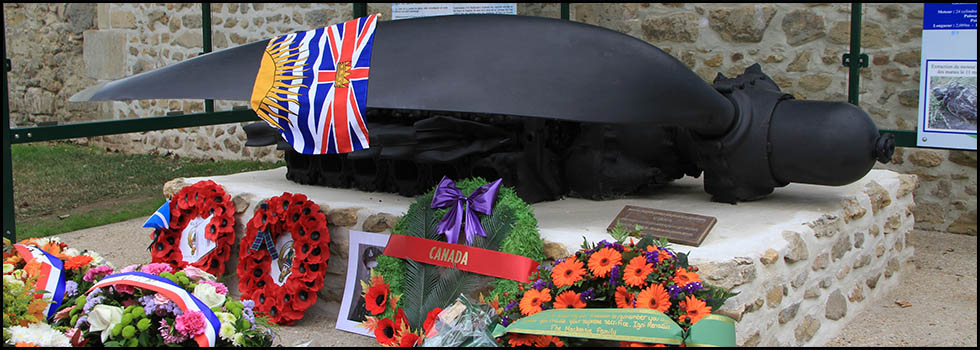
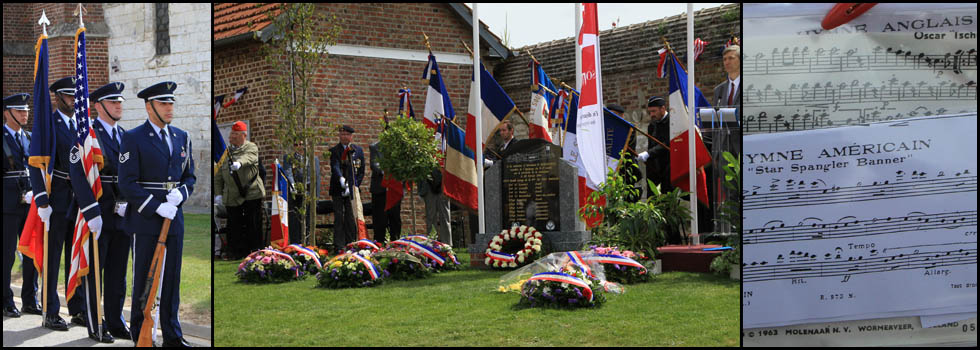
On 23rd June 2018, a memorial honouring Squadron Leader Eugeniusz Horbaczewski was unveiled in the village of Velennes (Oise).